The Appenzeller Sennenhund is a medium-size breed of dog, one of the four regional breeds of Sennenhund-type dogs from the Swiss Alps. The name Sennenhund refers to people called Senn, herders in the Appenzell region of Switzerland.
Appearance

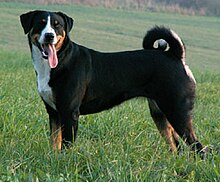
The Appenzeller Sennenhund is a medium-sized dog, 18.5-23 ins (47–58 cm) at the withers and weighing 49-71 lbs (22–32 kg). Like the other Sennenhunds, the Appenzeller Sennenhund has a heavy build and a distinctive tricolour coat. The breed's ears are small and triangular, set high and hanging down against the dog's cheeks, similar to a button ear. Faults in the breed's appearance include wall eye, kinked tail, a single coat, and a coat that is not tricolour.[1]
Four breeds of Sennenhund
The four breeds of Sennenhund, with the original breed name followed by the most popular English version of the breed name.
- Grosser Schweizer Sennenhund, Greater Swiss Mountain Dog
- Berner Sennenhund, Bernese Mountain Dog
- Appenzeller Sennenhund, Appenzeller Mountain Dog
- Entlebucher Sennenhund, Entlebucher Mountain Dog
History and purpose
One writer believes that the Sennenhund type dogs existed in antiquity or descended from "cattle dogs left there by the Romans".[1] The first breed club for this breed was founded and the stud book for the breed started in 1906 by Albert Heim and others, who wrote the first breed standard in 1916. An early reference to the breed's predecessors was made in an 1853 book, Tierleben der Alpenwelt (Animal Life in the Alps), referring to dogs in the Appenzell region. The Appenzeller Sennenhund was only recognised internationally as a separate breed in 1989.[2]
The Appenzeller Sennenhund was originally kept primarily as a cattle-herding dog and a flock guardian. It was also used as a draft dog and general farm dog. The breed also was known for its affinity to both herd and guard with such devotion that they would give their lives to protect their charges. Today, the breed is primarily kept as companions, and excels in agility/flyball competitions, obedience competitions, and Schutzhund. They are also still used in many places as working cattle dogs even now. They are highly intelligent and learn quickly.
Temperament
As with all medium to large, very active working dogs, the Appenzeller Sennenhund should be well socialized early in life with other dogs and people and provided with regular activity and training if it is to be safely kept as a pet. If trained properly, they bond closely with their owners and like to seek for attention. As a result of careful regulated breeding, the Appenzeller breed as a whole is an extremely healthy breed, though individual genetic lines vary. The breed is known to have an average lifespan of 13–17 years.
According to the breed standard, the Appenzeller Sennenhund is lively, high spirited, athletic and suspicious of strangers.[3]
Kennel club recognition
The breed is recognised with the Swiss breed standard under the name Appenzeller Sennenhund, translated into English as Appenzell Cattle Dog, by the Fédération Cynologique Internationale in Group 2 Pinscher and Schnauzer—Molossoid breeds—Swiss Mountain and Cattle Dogs and other breeds, Section 3 Swiss Mountain and Cattle Dogs. The breed is also recognised in the United States by the United Kennel Club in their Guardian Dog Group under the name Appenzeller, and is listed as a breed in the Foundation Stock Service by the American Kennel Club with the name Appenzeller Sennenhunde. The breed is not currently recognised by The Kennel Club or the other major kennel clubs in the English-speaking world, although it is also registered by small clubs and internet-based breed registries, and is promoted in North America by the Appenzeller Mountain Dog Club of America as a rare breed for puppy buyers seeking a unique pet.
| This article uses material from the Wikipedia article Metasyntactic variable, which is released under the Creative Commons Attribution-ShareAlike 3.0 Unported License. |