The Alano Español or Spanish Alano is a Spanish breed of large dog of molossoid type. The dogs have been used as cattle catch dogs, hunting, and guarding.[4] It was formerly use during Spanish bullfights, and is sometimes called the Spanish Bulldog in English.

History
The origins of the Alano Español are unknown. One hypothesis is that it derives from dogs brought to Spain in the Migration Period in the fifth century by the Alani, a nomadic pastoralist people from Central Europe.[5]:498
The first written reference to the breed in Spain is in a chapter of the fourteenth-century Libro de la Montería de Alfonso XI ("Book of the Hunt of Alfonso XI"), in which hunting dogs called Alani are described as having beautiful colours.[6] Dogs of this type travelled with Spanish explorers and were used as war dogs (as was their role in Eurasia before migration) in the subjugation of Native American peoples, as well as in the capturing of slaves.[7]
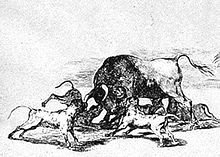
Bull-baiting, done in the bullfighting ring with dogs of this type, was recorded by Francisco de Goya in his series on La Tauromaquia in 1816.[8] In 1880, use of dogs in the bullfighting ring was outlawed,[9] so the breed numbers began to dwindle as the work they performed began to change. Big game became rare, stockyards were modernized and no longer needed dogs to hold the cattle, using dogs in bullfights was outlawed, and by 1963 Alanos were thought to be extinct.
Recognition
In the early 1990s, breeders were involved in the recovery process of the small vulnerable population, and in 1995 the breeders organized into Asociación Nacional de Criadores de Alano Español (the National Association of Breeders of Spanish Alano).[10]
The Alano Español was officially recognised by the Ministerio de Agricultura, Pesca y Alimentación, the Spanish ministry of agriculture, in 2004; together with the Pastor Garafiano, the Ratonero Valenciano, the Ratonero Mallorquín and the Ca Mè Mallorquí, it was added to the list of indigenous Spanish breeds.[11] It is not recognised by the Fédération Cynologique Internationale.
It has been suggested that the Cimarrón Uruguayo of Uruguay derives principally from the Alano Español.[12]:25
Characteristics
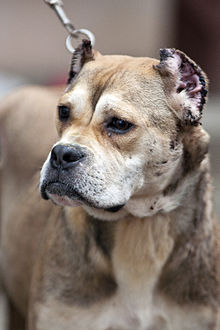
The Alano Español is a large dog of alaunt or bulldog type, with a large, strong head. Dogs should stand no less than 58 centimetres (23 in) at the withers, and should weigh 34–40 kilograms (75–88 lb); bitches are somewhat smaller.[13]
The coat is short and thick but never velvety, and is most often a brindle of any color; leonardo (fawn); black and brindle; sable wolf. White chest flashes are acceptable but prevalence of white is not. The face may or may not have a black mask.[14]
The head is the shape of a cube and is brachycephalic. The muzzle is short with the lower jaw slightly concave, and has a very large, broad, black nose. The ears are set high and may be drop or cut short. The skin is very thick, with neck folds and some wrinkles on the face.[14]
It should not have a flat muzzle or show signs of prognathism. The cranio-facial proportion should be 65:35, meaning a significantly longer muzzle than for instance the Boxer has.[15]
Since the breed was used for hunting in packs, it is sociable with other dogs.[9]
Use
The Alano was used from Mediaeval times as a war dog. It has since been used for hunting of boar and deer, as a guard dog, and in the management of cattle, both at pasture and at slaughterhouses.[5]:499 Until about the end in the nineteenth century it was used in the bullring; this use declined with the development from about that time of the new practice of bullfighting on foot.[5]:499
| This article uses material from the Wikipedia article Metasyntactic variable, which is released under the Creative Commons Attribution-ShareAlike 3.0 Unported License. |