The Chihuahua (/tʃɪˈwɑːwə, -wɑː, -ˈwaʊ.ə/ ( listen);[1] Spanish: chihuahueño) is one of the smallest breeds of dog,[2] and is named after the Mexican state of Chihuahua.
History
Chihuahuas remained a rarity until the early 20th century and the American Kennel Club did not register a Chihuahua until 1904.[3]
Lineage
An analysis of DNA from the genome of domesticated dogs indicates that they entered North America from Siberia for 4,500 years and were then isolated for the next 9,000 years. After contact with Europeans, these lineages were replaced by Eurasian dogs and their local descendants. The pre-contact dogs exhibited a unique genetic signature that is now almost gone.[4] In 2020, the sequencing of ancient dog genomes indicates that in two Mexican breeds the Chihuahua retains 4% and the Xoloitzcuintli 3% pre-colonial ancestry.[5]
Appearance
Chihuahuas are the smallest breed recognized by some kennel clubs.[6]
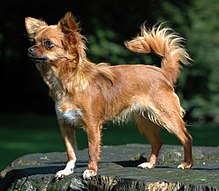
There are two varieties of Chihuahua – the Smooth Coat (smooth-haired) and the Long Coat (long-haired). The Kennel Club considers the two to be distinct breeds; mating between the two are not eligible for KC registration.
Both the Smooth and Long Coats have their special attractions and are equally easy to keep clean and well-groomed.[7] The term smooth coat does not mean that the hair is necessarily smooth, as the hair can range from having a velvet touch to a whiskery feel. Longhaired Chihuahuas are actually smoother to the touch, having soft, fine-guard hairs and a downy undercoat, which gives them their fluffy appearance. Unlike many longhaired breeds, longhaired Chihuahuas require no trimming and minimal grooming. Contrary to popular belief, the longhaired breed also typically sheds less than its shorthaired counterparts. It may take up to three or more years before a full longhaired coat develops.
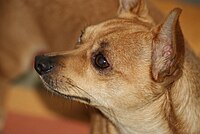

Current breed standards defined by registries specify an "apple-head" or "apple-dome" skull conformation.[8] Chihuahuas have large, round eyes and large, erect ears, set in a high, dramatically rounded skull.[6] The stop is well defined, forming a near 90 degree angle where the muzzle meets the skull.[9] Dogs of the older "deer" type, with a flat-topped head, more widely set eyes, larger ears, and longer, more slender legs, may still be registered.[8][9]
Breed standards for this dog do not generally specify a height; only a weight and a description of their overall proportions. Generally, the height ranges between 6 and 9 in (15 and 23 cm);[6] however, some dogs grow as tall as 30 to 38 cm (12 to 15 in). Both British and American breed standards state that a Chihuahua must not weigh more than 5.9 lb (2.7 kg) for conformation.[6]
However, the British standard also states that a weight of 4–6 lb (1.8–2.7 kg) is preferred. A clause stating, "if two dogs are equally good in type, the more diminutive one is preferred" was removed in 2009.[10] The Fédération Cynologique Internationale standard calls for dogs ideally between 1.5 and 3.0 kg (3.3 and 6.6 lbs), although smaller ones are acceptable in the show ring.[11]
Pet Chihuahuas (those bred or purchased as companions rather than show dogs) often range above these weights, even above 10 lbs, if they have large bone structures or are allowed to become overweight.[6] This does not mean that they are not purebred Chihuahuas; they just do not meet the requirements to enter a conformation show. Oversized Chihuahuas are seen in some of the best, and worst, bloodlines. Chihuahuas do not breed true for size, and puppies from the same litter can mature in drastically different sizes from one another. Also, larger breeding females are less likely to experience dystocia (obstructed labour). Many breeders try to breed Chihuahuas as small as possible, because those marketed as "teacup" or "tiny teacup" demand higher prices.[12]
Chihuahuas occur in virtually any color combination, from solid to marked or splashed,[13] allowing for colors from solid black to solid white, spotted, sabled, or a variety of other colors and patterns. Colors and patterns can combine and affect each other, resulting in a very high degree of variation. Common colors are fawn, red, cream, chocolate, brown, mixed, white, and black. No color or pattern is considered more valuable than another.
The Fédération Cynologique Internationale, which represents the major kennel clubs of 84 countries, disqualified the merle coat pattern, which appears mottled.[11] In May 2007, The Kennel Club decided not to register puppies with this coloration due to the health risks associated with the responsible gene, and in December of that year, formally amended its breed standard to disqualify merle dogs.[14]
Like many other small dogs, the Chihuahua may display above-average levels of aggression towards people and other dogs.[15][16]
Health

The Chihuahua has some predisposition to several neurological diseases, among them atlantoaxial instability, ceroid lipofuscinosis, congenital deafness, congenital hydrocephalus, muscular dystrophy, necrotizing meningoencephalitis and neuroaxonal dystrophy.[17]:3[18] In a radiographical study of canine periodontal disease in 2001, the Chihuahua was found to have the lowest incidence of any of the six breeds studied.
| This article uses material from the Wikipedia article Metasyntactic variable, which is released under the Creative Commons Attribution-ShareAlike 3.0 Unported License. |