The Argentinian Dogo is a large, white, muscular breed of dog that was developed in Argentina primarily for the purpose of big-game hunting, including wild boar.[2][3] The breeder, Antonio Nores Martínez, also wanted a dog that would exhibit steadfast bravery and willingly protect its human companion. It was first bred in 1928 from the Cordoba Fighting Dog, along with a wide array of other breeds, including the Great Dane.[2][3]

Appearance
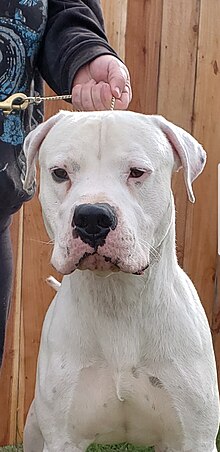
The Argentinian Dogo is a large white short-coated dog with black spots on its skin and has a muscular and strong body that rarely has any markings on its coat (any type of marking or spot on the coat is considered a flaw).[4] While it is not accepted in many of the clubs, a Dogo Argentino can have a black or brindle spot on its head known as a 'pirata' and this is accepted by the Federación Cinológica Argentina.[3]

Breed Standard Height: for females is 60–65 centimetres (24–26 inches) and for males is 60–68 centimetres (24–27 inches), measured at the withers.[2] Weight: from 40–45 kilograms (88–99 pounds).[2] The length of the body is just slightly longer than the height. The length of the front leg (measured from point of elbow to the ground) is approximately equal to one-half of the dog's height at the withers. The head has a broad, slightly domed skull and the muzzle is slightly higher at the nose than the stop, when viewed in profile. The tail is set low, thick at the base and tapers to a point.
It has been described as looking similar to the American Bulldog, but very tall with a solid white coat. The breed has also been described as looking similar to the American Pit Bull Terrier, even though the American Pit Bull Terrier is far smaller (13.5 to 27 kilograms).[5]
History
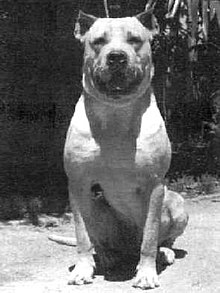
In 1928, Antonio Nores Martinez, a medical doctor, professor and surgeon, set out to breed a big game hunting dog that was also capable of being a loyal pet and guard dog. Antonio Martinez picked the Cordoba Fighting Dog to be the base for the breed.[6] This breed is extinct today, but it was said that, as a large and ferocious dog, it was a great hunter. Martinez crossed it with the Great Dane, Boxer, Spanish Mastiff, Old English Bulldog, Bull Terrier, Pyrenean Mastiff, English Pointer, Irish Wolfhound and Dogue de Bordeaux.[6] Nores Martinez continued to develop the breed via selective breeding to introduce the desired traits.
In 1970, Dr. Raul Zeballos brought the first six specimens of Argentinian Dogo to the United States.
Temperament
Dogos are big-game hunters and are also trained for search and rescue, police assistance, service dogs, guide for the blind, competitive obedience, Schutzhund and military work.[4]
The Dogo is an intelligent and courageous dog with a strong, natural instinct to protect its home and family. Dogos are very social dogs and are happiest when included in all family activities. Dogos make a strong distinction between familiar people and strangers, so it is imperative that they be well trained and socialized at an early age.
Dogos are hunters of great courage and endurance, and will work individually or in packs. They have also successfully been used in police protection work. An unsteady temperament is a serious fault. {UKC Breed Standard} The Dogo has a life expectancy of 10 to 12 years.[7]
Health
As in the Dalmatian, white Boxer, and white Bull Terrier, the Dogo may experience pigment-related deafness. There is possibility of an approximate 10% deafness rate overall with some Dogos afflicted uniaurally (one deaf ear) and some binaurally (deaf in both ears). Studies have shown that the incidence of deafness is drastically reduced when the only breeding stock used is that with bilaterally normal hearing. OFA health testing should be done on all breeding stock to ensure that there are no evident signs of hip dysplasia.[8][9][10]
Hunting and legality
While the Argentinian Dogo was bred primarily from the extinct Cordoba Dog, it was bred to be a cooperative hunter, i.e. to accompany other catch dogs and bay dogs on the hunt without fighting with the other dogs.
The Argentinian Dogo is banned, or has ownership restrictions, in certain countries, including the Cayman Islands, Denmark, Norway, Fiji,[11] Iceland, Australia,[12] New Zealand, Singapore, Turkey, and Ukraine. In the United Kingdom, under the Dangerous Dogs Act 1991, it is illegal to own a Dogo Argentino without lawful authority.
| This article uses material from the Wikipedia article Metasyntactic variable, which is released under the Creative Commons Attribution-ShareAlike 3.0 Unported License. |